7 Tic Tac Toe Variations: 4×4, Ultimate, 3D and More
The familiar 3×3 Tic Tac Toe board is easy to learn, but it is far from the only way to play. Change the board size, reverse the winning condition, or let players choose either symbol, and you get a different strategy game. Some Tic Tac Toe variations make matches longer; others completely overturn the instincts that work in the classic version.
Below are seven interesting ways to play Tic Tac Toe, including 4×4, 5×5, Ultimate, Misère, and 3D versions. Each has its own rules, so the important question is not only “How big is the board?” but also “What counts as a win?” These are informational variations you can try with a paper board or a compatible game set. On PlayTicToe.online, the playable game is the classic 3×3 version, against the computer or another person on the same device.
Classic Tic Tac Toe: The Starting Point
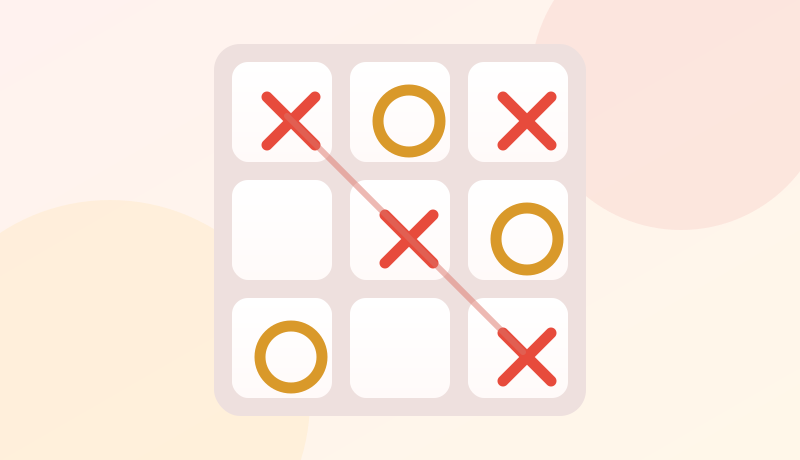
In standard Tic Tac Toe, two players take turns placing X and O in empty cells of a 3×3 grid. The first to complete three matching symbols in a horizontal, vertical, or diagonal line wins. If all nine cells fill without a winner, the game is a draw.
The small board makes it easy to understand threats. More importantly, the game is solved: perfect play from both sides ends in a draw. Variations become appealing when players want fresh choices, a harder memory challenge, or a reason to rethink familiar openings.
1. 4×4 Tic Tac Toe: Four in a Row
The simplest expansion uses a four-by-four board containing 16 squares. A clear, balanced house rule is four in a row wins, horizontally, vertically, or diagonally. Players still alternate X and O, and each square can be used only once.
Here is the blank board:
 . | . | . | .
---+---+---+---
 . | . | . | .
---+---+---+---
 . | . | . | .
---+---+---+---
 . | . | . | .
The longer lines demand more planning than a 3×3 board.
Agree on the winning length before starting. A 4×4 game requiring three in a row is a different game from one requiring four, with substantially different strategic balance. For beginners, four in a row is the most intuitive rule for a 4×4 board.
2. 5×5 Tic Tac Toe: More Room for Strategy
A 5×5 game uses 25 cells. There is no single universal winning rule for casual 5×5 Tic Tac Toe: some groups choose four in a row, while others require five. Both are legitimate house-rule variants, but they feel different.
With four in a row, players can form winning lines without using the full board width. That creates more possible threats and makes timing important. With five in a row, the line must span a full row, column, or long diagonal on a 5×5 board, so there are fewer possible wins.
| Board | Suggested target | Character of play |
|---|---|---|
| 3×3 | 3 in a row | Short, highly studied games |
| 4×4 | 4 in a row | Longer line planning |
| 5×5 | 4 in a row | More threats and space |
| 5×5 | 5 in a row | Fewer full-length winning lines |
3. Ultimate Tic Tac Toe: Nine Boards in One
Ultimate Tic Tac Toe takes nine ordinary 3×3 boards and arranges them in a larger 3×3 pattern. Each small board can be won with three in a row. To win the overall game, you usually need to claim three small boards in a row across the large grid.
The cell you choose determines your opponent’s next small board: choose a top-right cell to send them to the top-right board, or a center cell to send them to the center board.
How to Play Ultimate Tic Tac Toe
- Start with nine empty 3×3 boards arranged as a large grid.
- The opening player makes a move in an allowed small board.
- The cell chosen sends the opponent to the corresponding small board.
- Win a small board by making three of your marks in a line.
- Win the overall game by capturing three small boards in a line.
When the directed board is unavailable, a common rule allows a free choice among playable boards. Confirm house rules first.
4. Misère Tic Tac Toe: Three in a Row Loses
Misère, or reverse Tic Tac Toe, changes one essential rule: the player who completes three of their own marks in a line loses. Instead of building a winning row, you try to avoid creating one. Your moves may eventually force the other player into an uncomfortable choice.
The normal center-first instinct needs rethinking. The center connects four lines, so it can create risks as the board fills. A corner, normally useful for attacks, may instead reduce the number of immediate losing lines you are involved in.
For a simple two-player home version, agree that the first person to complete three matching marks loses. If the board fills with no losing line, call it a draw. More elaborate misère rule sets are possible, but everyone should use the same convention.
5. Wild Tic Tac Toe: Choose X or O on Every Turn
In Wild Tic Tac Toe, each player may choose either X or O on their turn. A player wins by completing three identical marks in a line, regardless of whether the line contains X or O. The symbol no longer identifies who owns a move; the player who places the final mark in the completed line claims the win.
For example, imagine a row with X, X, and one empty cell. Either player could place X in the gap and win immediately. The next player therefore has to look at possible lines of both symbols, not only their own traditional mark.
Wild Tic Tac Toe is a useful lesson in threat detection because ownership of symbols no longer protects you. A move that appears to help the opponent may actually help you finish a line first.
6. 3D Tic Tac Toe: Think Across Layers
Three-dimensional Tic Tac Toe extends the grid vertically. A well-known version uses four 4×4 boards stacked into a 4×4×4 cube. Players aim to place four of their marks along a straight line. That line can lie within one layer, run through layers vertically, or follow a diagonal through three-dimensional space.
Players must check threats within each layer and across layers.
Do not confuse 3D Tic Tac Toe with cosmetic 3D animations. A raised-looking classic board still follows 3×3 rules; true 3D Tic Tac Toe adds another dimension to the playing space and changes the strategic problem.
7. Notakto: Everyone Plays X
Notakto is another surprising relative of Tic Tac Toe. Both players place X, and completing a line of three Xs causes the relevant board to become unavailable. The widely discussed version uses multiple boards and misère-style play, with the player who ends the last active board losing.
This removes the usual X-versus-O identity. Instead, players share the same set of marks, so strategy revolves around which move will leave the other person with an unavoidable bad option. The rules feel unusual at first because a move can bring a board closer to closure without distinguishing one player's symbols from the other's.
Agree on the number of boards and mark completed boards as inactive.
Which Tic Tac Toe Variation Should You Try?
Choose 4×4 if you want an easy transition to bigger boards. Try 5×5 with four in a row if you enjoy planning simultaneous threats. Pick Ultimate if you like strategic consequences that extend beyond the square where you place a mark. Use Misère when you want the classic game to feel backward, and choose Wild for a quick rule change with surprisingly different tactics. Try 3D for spatial reasoning or Notakto for something experimental.
If you are still learning classic strategy, begin with how to win Tic Tac Toe and the best opening move. The basic ideas of immediate threats and careful replies remain helpful, even when the exact rules change.
For background on variant types, see Tic-tac-toe variants and the mathematical overview at Wolfram MathWorld.
Frequently Asked Questions
What are the most popular Tic Tac Toe variations?
Common examples include 4×4, 5×5, Ultimate Tic Tac Toe, Misère, Wild Tic Tac Toe, and three-dimensional versions. The rules vary in board size, winning length, or the objective itself.
How do you play 4×4 Tic Tac Toe?
Draw a 4×4 grid, alternate X and O, and aim for four matching marks in a straight row, column, or diagonal. Agree on the four-in-a-row rule before starting.
What is different about Ultimate Tic Tac Toe?
It contains nine connected small boards. The position of your move inside a small board directs where your opponent plays next, so every turn affects both a local board and the larger game.
What happens in reverse Tic Tac Toe?
In the Misère version described here, completing a line of three of your own marks makes you lose rather than win. The players try to avoid forming that line.
Can I play all these variations on PlayTicToe.online?
Not currently. PlayTicToe.online provides classic 3×3 Tic Tac Toe against the computer or a local friend. The variations in this guide are explained for educational and offline play.