Best First Move in Tic Tac Toe: Center or Corner?
What is the best first move in Tic Tac Toe? For a straightforward, reliable opening, take the center. It belongs to more winning lines than any other square. If you enjoy setting traps for human opponents, a corner is also an excellent first move because many replies to it are losing mistakes. Neither approach guarantees victory: with flawless play from both sides, every standard 3×3 game is a draw.
Your opening affects how easy the next decisions become. This guide compares center, corner, and edge starts, shows the best responses when you move second, and explains why the second move is often more important than the first. You can try each opening in a real match on our free Tic Tac Toe game.
Understand the Three Types of Opening Squares
Although the grid contains nine spaces, symmetry means there are only three fundamentally different first moves: center, corner, or edge. Rotating the board turns one corner into another, so you do not need to memorize nine different opening theories.
 1 | 2 | 3
---+---+---
 4 | 5 | 6
---+---+---
 7 | 8 | 9
- Center: Square 5.
- Corners: Squares 1, 3, 7, and 9.
- Edges: Squares 2, 4, 6, and 8.
Each square participates in a different number of winning lines:
| Opening type | Winning lines containing that square | General value |
|---|---|---|
| Center | 4 | Most connections, easy to learn |
| Corner | 3 | Strong intersections and practical traps |
| Edge | 2 | Fewer connected paths, more defensive care |
These counts measure flexibility, not guaranteed wins.
Why the Center Is the Best First Move for Beginners
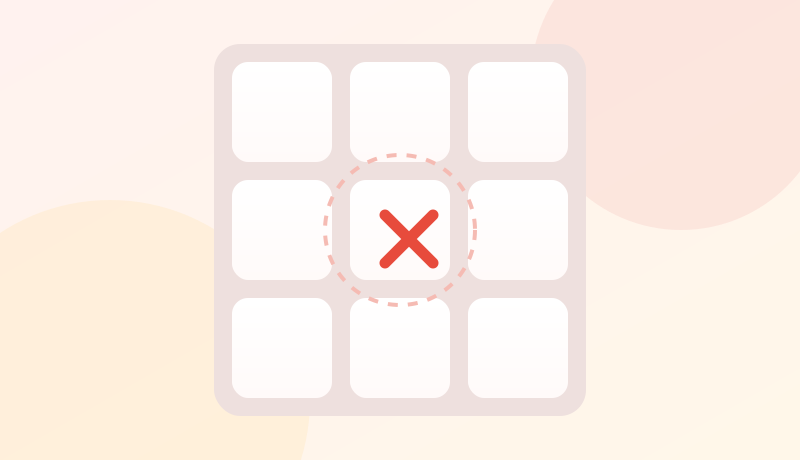
Starting at the center gives you a mark in both diagonals, the middle row, and the middle column. Your next move can interact with several potential lines. More importantly, this makes the board easier to read: many threats will pass through the square you already control.
Imagine you put X in square 5:
 . | . | .
---+---+---
 . | X | .
---+---+---
 . | . | .
Your opponent should take a corner. If they instead choose an edge, you may be able to create a fork with accurate follow-up moves. Do not assume the fork exists immediately; evaluate the response, check for urgent threats, and then choose the next square.
The center also has a psychological advantage for new players: it gives you a consistent starting point. A repeated opening can help you learn what changes when O responds in different places. That consistency is valuable while you are still learning blocks and forks.
Why Corner Openings Can Be More Dangerous for Opponents
A corner touches one row, one column, and one diagonal. It therefore has fewer connections than the center but still supports several attacking directions.
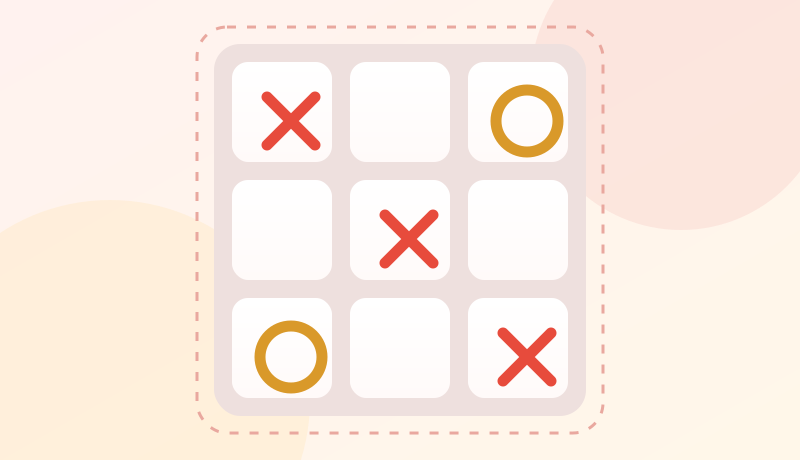
Suppose X begins at square 1. O's safe reply under optimal play is square 5. If O chooses a different square, X can force a victory with accurate continuation. In other words, the corner opening offers the second player less freedom to reply safely than a center opening does.
That is why some experienced players prefer corners against casual human opponents. An opponent may know the slogan “corners are strong” and take another corner rather than the center. That apparently reasonable reply may already be the decisive mistake.
Of course, a confident defender who takes the center and continues correctly will still draw. A corner is not a secret cheat code, and repeatedly using the same follow-up without observing O's move is a mistake.
For the full move-by-move framework, read How to Win at Tic Tac Toe.
Are Edge Openings Ever a Good Idea?
Edges are not automatically losing first moves. With optimal continuation, the first player can still secure a draw. However, an edge touches just two winning lines and lacks any diagonal connection, so it tends to produce fewer useful intersections.
A player who opens on an edge may need more precise follow-up moves to defend the center and corners. Against someone unfamiliar with the opening, it might introduce surprise, but surprise alone is not a reliable strategy.
If your goal is to learn fundamental skills, practice the center and corners first. Later, try an edge opening as an exercise: can you identify the opponent's threats without depending on a favored central square? That is a worthwhile drill, even if it is not your best everyday choice.
The Best Second Move in Tic Tac Toe
The opening becomes meaningful only when the other player responds. If you are O, the following guide is an excellent place to start:
| X's opening | Recommended reply for O | Why |
|---|---|---|
| Corner | Center | Prevents X from forcing a win through early forks |
| Center | Any corner | Preserves a drawing continuation |
| Edge | Center | Gives strong defensive line coverage |
These are sound opening replies, not the complete strategy for the entire match. After the first response, both players must still check immediate wins, blocks, and forks.
If X Opens in a Corner, Take the Center
This is the simplest critical rule for a second player to remember. Without center control, X can coordinate the corner with another square to create an eventual unanswerable double threat. If X chooses opposite corners while you control the center, watch carefully: a suitable edge move can prevent the fork.
If X Opens in the Center, Take a Corner
Your corner cuts across a potential diagonal and gives you lines of your own. Replying with an edge may allow X to arrange a fork. Once you have taken the corner, reassess after each X move rather than following a fixed sequence.
If X Opens on an Edge, Take the Center
The center offers a comfortable defensive plan. There are other safe replies to some edge openings, but you do not need to memorize them to play well. Securing the center and then prioritizing threats is a practical solution.
The Mistake That Matters More Than the First Move
Players often ask where to go first in Tic Tac Toe and stop studying after that. Yet a defensively incorrect second move can turn a drawable position into a forced loss. To understand this, compare two players: both see X start in a corner, but one answers in the center while the other chooses a nearby corner. Only the first preserves the safe drawing route.
This explains why an opening must be studied as a pair of moves, not as a single X on an empty board. When reviewing a lost game, examine the first response before blaming your original opening. You may find that your first choice was sound, but the next decision failed to stop a future fork.
A competitor's analysis of 3,417 online games illustrates how early responses can decide outcomes in human play. Those observations are from that site's players and should not be treated as universal probabilities.
How to Practise Center and Corner Openings
Play at least six games, alternating who goes first. Start two games from the center, two from a corner, and two from an edge. After each match, write down the first position where someone could win on the next move or create a fork.
Next, repeat the center and corner starts against a stronger computer opponent. Your aim is not to win every round, but to finish without allowing an avoidable loss. Finally, use local two-player mode to explain the correct reply to a friend without looking at a guide.
If you can consistently identify the safe second move, you are ready for the harder question: How to Force a Draw Against Impossible Tic Tac Toe.
Frequently Asked Questions
What is the best first move in Tic Tac Toe?
The center is the easiest strong recommendation because it belongs to four winning lines. A corner is also excellent and can create more defensive challenges for inexperienced opponents.
Is the center or corner better in Tic Tac Toe?
Both can maintain a draw with perfect continuation. The center is easy to understand and connects four lines; a corner can punish an incorrect first reply more quickly.
Can you win by going first in a corner?
You can force a win if O replies incorrectly and you exploit the mistake. You cannot guarantee victory when O answers in the center and keeps defending accurately.
What if my opponent takes the center first?
Take a corner as O, then check each move for immediate threats and forks. Taking an edge immediately is generally a losing response against perfect X play.
Is an edge opening always a mistake?
No. An edge opening can still draw under perfect play. It simply connects fewer winning lines and is usually less convenient for beginners than the center or a corner.