How to Beat Impossible Tic Tac Toe: Force a Draw Against AI
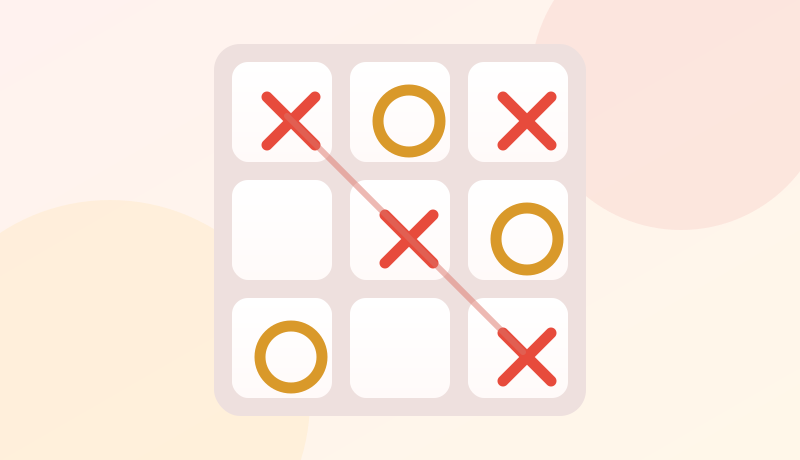
If you have tried to beat an impossible Tic Tac Toe computer and lost repeatedly, the difficulty is doing its job. A genuinely perfect 3×3 Tic Tac Toe opponent cannot be defeated from the initial board. It can always answer a threat or prevent a fork in time. But there is good news: you do not have to lose either. By following correct defenses, you can force a draw against a perfect AI, whether you go first or second.
Learn the safe replies and recognise the mistakes that permit a forced win. Then play Tic Tac Toe against the computer on its strongest setting.
Can You Beat Impossible Tic Tac Toe?
Not if “impossible” means the computer always chooses an optimal move under the normal rules. Classic Tic Tac Toe is mathematically solved. From an empty 3×3 board, two perfect players reach a draw. A perfect computer will never choose a losing line when a draw or win remains available.
The distinction between beating and not losing is crucial. A win requires the computer to make a mistake. A draw requires only that you avoid making one. Since you control your moves, you can aim for the latter even when your opponent's decisions are flawless.
How Does Impossible Tic Tac Toe AI Work?
Many unbeatable implementations use minimax, an algorithm for turn-taking games with opposing goals. The program explores legal moves, predicts the opponent's best replies, and continues until it reaches a finished game. It then works backward to select a move with the strongest guaranteed outcome.
For example, a program can evaluate terminal results as:
| Final result for the computer | Example evaluation |
|---|---|
| Computer wins | +1 |
| Draw | 0 |
| Computer loses | −1 |
The computer prefers a win when available. If a win cannot be forced, it protects a draw. It refuses a tempting-looking move when a clever response would turn the position into a loss. Efficient implementations may use alpha-beta pruning or favor faster wins and slower losses, but the essential principle remains the same.
Minimax does not need to read your mind or cheat. It simply considers what you could do and chooses a response that remains safe against your strongest option. For a deeper look at the mathematics, see Wolfram MathWorld's Tic-Tac-Toe entry.
How to Force a Draw When You Go First
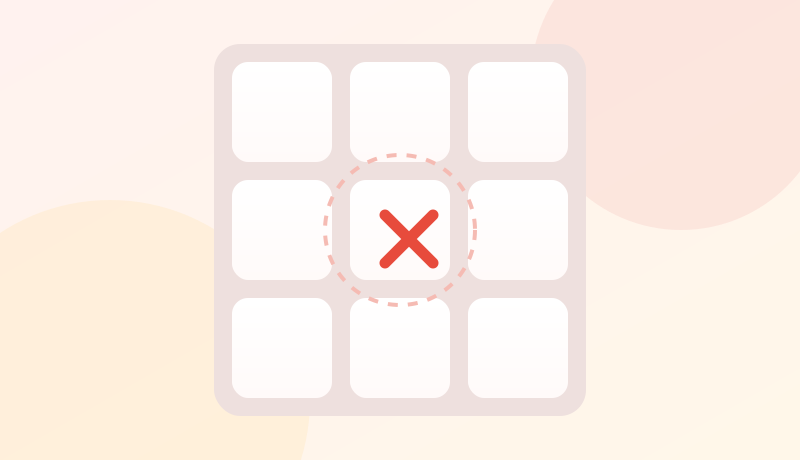
If you play X first, opening in the center is an easy strategy to learn. The center touches four winning lines, giving you flexible follow-up options. A corner is also mathematically sound, but you must still recognize the computer's responses.
Start with this board:
 . | . | .
---+---+---
 . | X | .
---+---+---
 . | . | .
A perfect O can reply in a corner and preserve a draw. From that point, there is no universal instruction such as “always choose the opposite corner.” Instead, examine the actual position. Ask whether O threatens a win next move, whether a fork is possible, and whether your intended move would give O an unanswerable threat.
A Reliable Decision Order for X
- Finish three in a row if you can win immediately.
- Block if O threatens to win next turn.
- Look for a fork that creates two winning threats.
- Prevent O from creating such a fork.
- Only then choose among otherwise safe positional squares.
If the AI has not made a mistake, the appropriate move will preserve a draw rather than create a guaranteed win. You do not need to outsmart minimax; you need to avoid handing it a winning continuation.
How to Force a Draw When the Computer Goes First
Going second is where many players lose before they realize they are in danger. Fortunately, the correct initial reply is easy to learn:
| AI's first move | Your safe response |
|---|---|
| Corner | Take the center |
| Center | Take any corner |
| Edge | Take the center as a simple safe option |
These replies protect the drawing possibility. They do not guarantee that every later move will also be safe.
Example: The AI Starts in a Corner
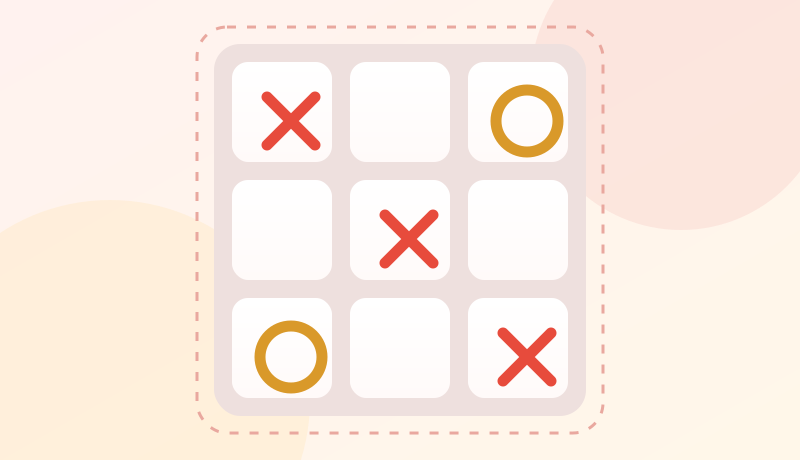
Imagine the computer puts X at square 1, the top-left corner. You play O at square 5, the center. That is the correct defense. If you had played O in another corner instead, a perfect X could later force a win.
Now suppose X takes square 9, the corner opposite its first. You hold the center while X holds two opposite corners. Choose an edge, rather than an unoccupied corner, to avoid giving X a fork. Watch for any immediate line the computer creates afterward.
Example: The AI Starts in the Center
If the computer opens at square 5, choose a corner such as square 1. That interrupts a diagonal and leaves space for your own future line. Choosing an edge on this first response can let a perfect X force a win. After taking the corner, continue scanning for threats rather than assuming one safe opening move completes your defense.
For a more detailed comparison, see our best first move in Tic Tac Toe guide.
Why Forks Are the Real Danger Against Perfect AI
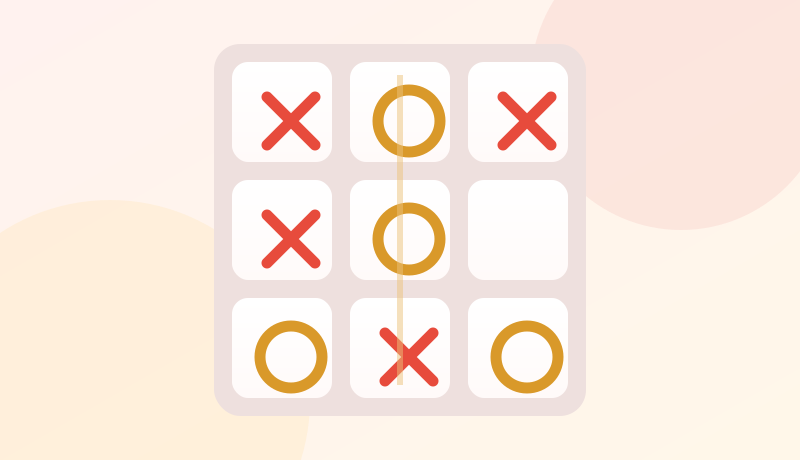
Most players can recognize a simple row containing two Xs and one empty square. A fork is harder: one move establishes two separate lines that would win on the next turn. You can block only one winning square, so the other remains available.
A common mistake is defending a single visible line while ignoring that the AI's next move can set up a second line simultaneously. Against minimax, such mistakes are punished without hesitation. The computer does not need a lucky guess; it already knows the consequences.
Before you choose a move, imagine the opponent's next turn. Could it create two threats? If yes, prevent that fork now. Sometimes your best defense is to make an immediate threat of your own so that the AI must block instead of forking. This technique is especially useful when simply occupying one square cannot stop every possible fork.
Five Mistakes That Make Impossible AI Look Unfair
1. Answering a Corner With Another Corner
When a perfect X opens in a corner, O needs the center to preserve a draw. A matching corner response looks balanced but loses against correct continuation.
2. Taking an Edge After the AI Opens in the Center
An edge may be attractive because it seems close to two other squares, but a corner is the proper safe reply to a center opening.
3. Forgetting to Block a Direct Win
A positional plan never outranks an immediate emergency. If the computer has two marks in a row with an empty third square, block unless your move wins immediately.
4. Repeating a Memorized Sequence Blindly
Perfect AI may have more than one equally strong move. Some implementations vary among them, so memorizing one game is not a complete strategy. Read the board instead.
5. Mistaking a Draw for Failure
Against truly perfect play, drawing is the highest result available. Treat it as evidence that your defense held up throughout the game, not as a disappointing non-result.
A Three-Stage Practice Challenge
Begin on a beginner computer difficulty and identify every immediate winning or blocking square. Next, use a medium opponent and practise stopping forks before they form. Finally, select the hardest available difficulty and try to complete five games without losing, alternating who starts if the controls allow it.
After each loss, record the earliest move that changed a drawable position into a losing one. Was it a wrong first reply? A missed direct threat? A fork you noticed too late? Diagnosing that specific mistake is more effective than replaying the same opening mechanically.
For a general checklist that also works against human players, read How to Win at Tic Tac Toe Every Time.
Frequently Asked Questions
Can anyone beat impossible Tic Tac Toe?
A genuinely optimal Tic Tac Toe AI cannot lose from a fresh standard board. If an “impossible” opponent loses, its implementation may be imperfect or the game may be using different rules.
How do you tie impossible Tic Tac Toe?
Reply to a corner opening with the center, and to a center opening with a corner. After that, prioritize immediate wins, blocks, forks, and fork prevention. Correct play keeps the draw available.
Why does the computer always block me?
An optimal computer evaluates the results of possible moves. It can recognize when failing to block would allow an immediate loss, so it takes the defensive square.
Is minimax a type of artificial intelligence?
Yes. Minimax is a classical game-search algorithm used to choose decisions in adversarial games. It does not require machine learning or a large language model.
Does the first player always win against a computer?
No. The first player has more initiative against imperfect opposition, but perfect play from both players still ends in a draw.